Introduction
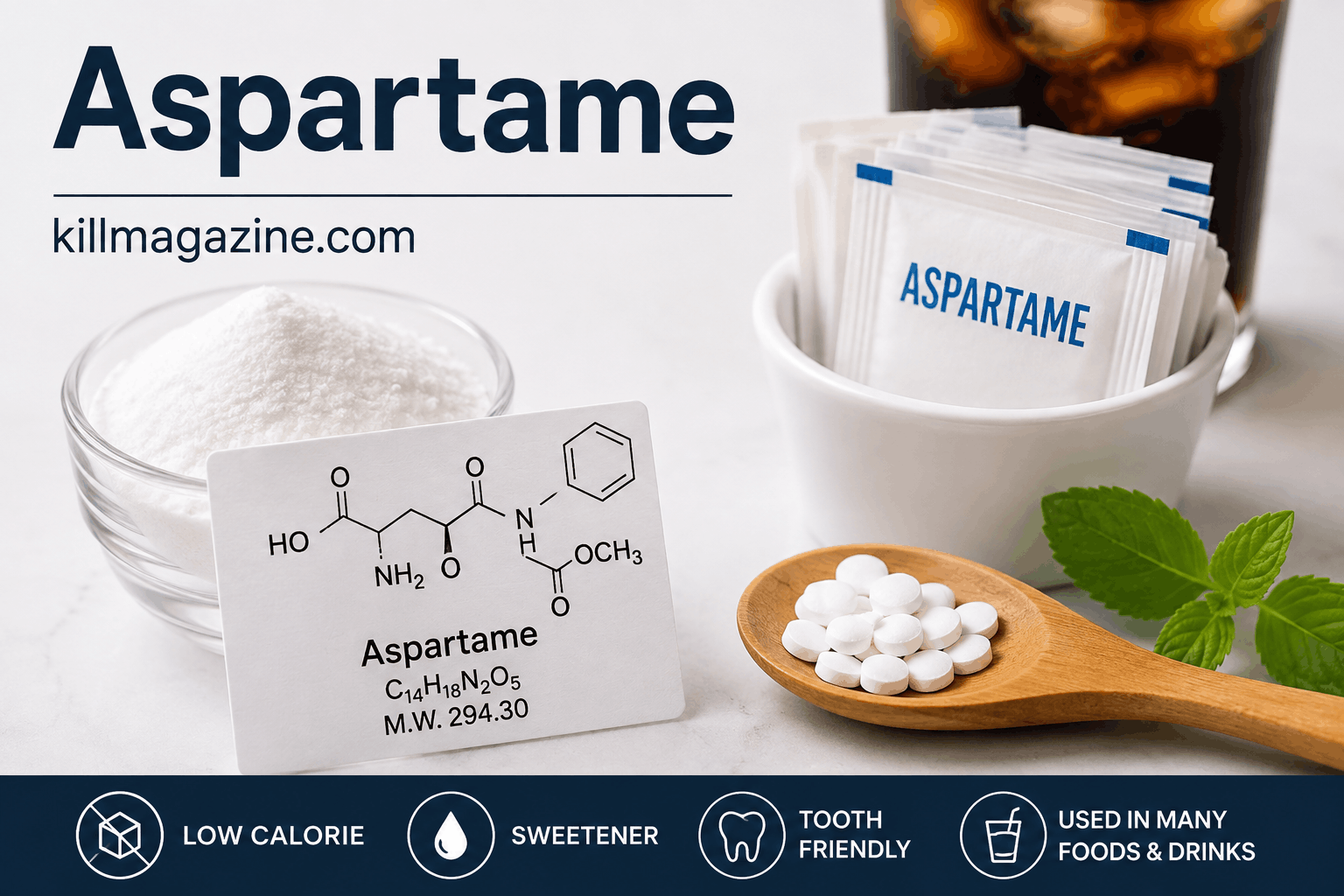
Aspartame is one of the most widely discussed low-calorie sweeteners in the world. It is found in many sugar-free and reduced-calorie foods and drinks, including certain soft drinks, chewing gum, tabletop sweeteners, desserts, and other products. Because it provides a very sweet taste with only a small amount needed, manufacturers have used it as an alternative to traditional sugar for decades.
At the same time, questions about aspartame safety, possible health effects, and cancer risk have attracted considerable public attention. Much of the recent discussion followed assessments released by the International Agency for Research on Cancer (IARC) and the Joint FAO/WHO Expert Committee on Food Additives (JECFA) in 2023.
Understanding this topic requires more than looking at a headline. Different scientific organizations evaluate food ingredients in different ways, and terms such as “hazard,” “risk,” and “acceptable daily intake” have specific meanings.
The U.S. Food and Drug Administration (FDA) continues to consider aspartame safe for the general population when used under approved conditions. JECFA maintained its existing acceptable daily intake in 2023, while IARC classified aspartame as “possibly carcinogenic to humans” based on limited evidence. The European Food Safety Authority (EFSA) has also previously concluded that aspartame is safe at current permitted exposure levels.
This article explains what aspartame is, where it is used, what experts say about its safety, and what consumers should know before making decisions about products containing this sweetener.
What Is Aspartame?
Aspartame is an intense low-calorie sweetener that is approximately 200 times sweeter than table sugar. Because it is so sweet, manufacturers can use much smaller quantities than they would need if using ordinary sugar.
According to the FDA, aspartame is chemically a dipeptide made primarily from two amino acids: phenylalanine and aspartic acid. It also contains a methyl group. These components are related to substances naturally found in protein-containing foods.
Aspartame has been used in food products for many years and is regulated as a food additive in the United States. The FDA first approved it for certain uses in 1974, and its permitted uses were expanded over subsequent years. The agency approved its use as a general-purpose sweetener in 1996.
Aspartame is not especially heat stable, which means it can lose sweetness when exposed to high temperatures. For this reason, it is generally less suitable for some baking applications than heat-stable sweeteners.
Where Is Aspartame Used?
Aspartame can be found in a variety of products, particularly foods and beverages marketed as sugar-free, diet, or reduced-calorie.
Examples can include:
- Certain diet soft drinks
- Sugar-free chewing gum
- Tabletop sweetener products
- Powdered drink mixes
- Some desserts
- Certain dairy products
- Puddings and similar products
- Other reduced-sugar foods and beverages
The exact ingredients vary from product to product. Consumers who want to determine whether a product contains aspartame should check its ingredient list.
Some products may also carry information about phenylalanine because this is particularly relevant to people with phenylketonuria (PKU).
Why Is Aspartame So Widely Used?
One major reason for the popularity of aspartame is its intense sweetness.
The FDA states that aspartame is around 200 times sweeter than table sugar. This means manufacturers can achieve a sweet taste using a relatively small quantity.
Unlike ordinary sugar, high-intensity sweeteners can contribute very few calories because only a small amount is required to produce sweetness. This is one reason they have been incorporated into some reduced-calorie and sugar-free products.
For consumers, replacing some sugar-containing foods or drinks with products containing low-calorie sweeteners can be one way of reducing sugar intake. However, the nutritional value of an entire food or beverage depends on all of its ingredients, not simply whether it contains aspartame.
Is Aspartame Safe?
The question “Is aspartame safe?” does not have to be answered by looking at a single study. Food-safety agencies evaluate a broad body of scientific evidence, including toxicology research, exposure estimates, metabolism, and human data.
The FDA states that it has reviewed more than 100 studies related to aspartame, including research examining potential effects on areas such as metabolism, the reproductive system, the nervous system, and carcinogenicity.
The FDA’s current position is that it does not have safety concerns about aspartame when it is produced and used according to approved conditions. The agency also continues to monitor scientific literature and information about consumer exposure.
EFSA has likewise previously assessed the available scientific evidence and concluded that aspartame is safe at current permitted exposure levels.
This does not mean that every scientific question about aspartame has disappeared. Instead, it means that major regulatory assessments have generally supported its safety when exposure remains within established limits.
Understanding the Acceptable Daily Intake
One of the most important concepts in discussions about food additives is the acceptable daily intake (ADI).
The ADI is an estimate of the amount of a substance that can be consumed every day over a person’s lifetime without appreciable health risk, based on the available scientific evidence and safety assessment.
The FDA has established an ADI for aspartame of 50 milligrams per kilogram of body weight per day.
JECFA, the international expert committee associated with WHO and FAO, has an ADI of 40 milligrams per kilogram of body weight per day.
These numbers should not be interpreted as targets for consumption. They are safety limits used by regulators and scientific experts when assessing dietary exposure.
The ADI is also based on safety factors intended to account for differences between experimental models and people, as well as differences in individual sensitivity.
Aspartame and Cancer: What Does the Evidence Say?
Cancer is one of the most frequently searched questions surrounding aspartame.
In July 2023, IARC classified aspartame as Group 2B, “possibly carcinogenic to humans.” This classification was based on limited evidence and represents a hazard assessment.
The word “hazard” is important.
A hazard assessment asks whether a substance could potentially cause harm under certain circumstances. It does not, by itself, tell consumers how much of the substance can safely be consumed.
At the same time, JECFA conducted a risk assessment focused on exposure and health risk. JECFA maintained its existing ADI of 40 mg/kg of body weight per day.
The WHO explained that the available evidence did not provide a sufficient reason to change this limit.
The FDA has also stated that it disagrees with IARC’s conclusion that the available studies support classifying aspartame as a possible human carcinogen. According to the FDA, its scientists identified significant limitations in some of the studies considered by IARC.
Therefore, it would be inaccurate to summarize the 2023 findings simply by saying that “WHO says aspartame causes cancer.” The assessments were more nuanced.
Hazard vs. Risk: Why the Difference Matters
The distinction between hazard and risk is particularly important when discussing food additives.
Imagine that a substance has the potential to cause an effect under certain conditions. Identifying that potential is a hazard assessment.
Risk assessment goes further. It considers factors such as:
- How much of the substance people consume
- How frequently they are exposed
- How the substance behaves in the body
- Available human and laboratory evidence
- Safety margins
- Typical and high exposure levels
This distinction explains why IARC could classify aspartame as a possible hazard while JECFA maintained its existing acceptable daily intake.
Consumers should therefore avoid interpreting the IARC classification as a statement that normal consumption automatically causes cancer.
What Does the FDA Say About Aspartame?
The FDA considers aspartame safe for the general population under approved conditions of use.
The agency notes that aspartame is one of the most extensively studied food additives in the food supply. Its evaluations have included research into toxicity, metabolism, reproductive effects, nervous-system effects, and carcinogenicity.
The FDA also monitors new scientific information and reassesses safety when relevant information becomes available.
According to the agency, the established ADI of 50 mg/kg body weight per day remains protective of public health.
The FDA’s position is therefore based on its evaluation of the total scientific evidence rather than on a single study or headline.
What Does WHO Say?
The 2023 WHO announcement involved assessments by two scientific bodies: IARC and JECFA.
IARC assessed the potential carcinogenic hazard of aspartame and placed it in Group 2B, meaning “possibly carcinogenic to humans.”
JECFA separately assessed the potential health risk associated with dietary exposure. It maintained the ADI at 40 mg/kg body weight per day.
WHO emphasized that the two assessments serve different purposes.
This is an important point for anyone researching aspartame health effects. The WHO announcement should be understood as a scientific assessment involving both hazard identification and risk evaluation, rather than as a simple declaration that aspartame is unsafe.
What Does EFSA Say About Aspartame?
The European Food Safety Authority has also evaluated aspartame.
EFSA’s comprehensive assessment concluded that aspartame and its breakdown products are safe for the general population at current exposure levels, with the exception of people with phenylketonuria, who need to manage phenylalanine intake.
EFSA’s work is significant because it represents an independent scientific risk assessment by a major food-safety authority.
The FDA also identifies EFSA among regulatory and scientific organizations that have evaluated aspartame and considered it safe at permitted levels.
Aspartame and Phenylketonuria (PKU)
One important exception in discussions about aspartame safety involves phenylketonuria, commonly called PKU.
PKU is a rare inherited condition in which the body has difficulty processing phenylalanine. Because aspartame contains phenylalanine, people with PKU need to avoid or restrict aspartame according to appropriate medical and dietary guidance.
This is why products containing aspartame are required to provide information about phenylalanine.
People with PKU should pay close attention to food labels and follow advice from their healthcare professionals or registered dietitians.
Possible Health Effects and Individual Responses
Online discussions sometimes attribute a wide range of symptoms to aspartame. However, consumers should be careful about treating personal reports or isolated claims as proof of a causal relationship.
Scientific evidence needs to be evaluated according to study quality, consistency, biological plausibility, exposure levels, and the overall body of research.
Different people may also have different dietary patterns and sensitivities. If someone notices a recurring reaction after consuming a particular food or beverage, discussing the issue with a qualified healthcare professional can be more useful than relying on internet claims.
For general consumers, major food-safety authorities continue to evaluate aspartame within established exposure limits.
Aspartame vs. Sugar
Aspartame and sugar serve similar purposes—providing sweetness—but they are chemically and nutritionally different.
| Feature | Aspartame | Table Sugar |
| Sweetness | About 200 times sweeter than sugar | Standard reference |
| Calories | Used in very small amounts | Provides calories |
| Common use | Sugar-free and reduced-calorie products | Broad range of foods |
| Blood glucose impact | Generally does not raise blood glucose like sugar | Raises blood glucose |
| Main consideration | Staying within established safety guidance | Managing added sugar intake |
This comparison does not mean that one ingredient is automatically better for every person. Dietary needs vary, and the overall quality of a person’s diet matters more than focusing on one ingredient in isolation.
How to Check Whether a Product Contains Aspartame
Consumers who want to limit or monitor their aspartame intake can start by reading the ingredient list.
Look for the word “aspartame” in the ingredients. Some products also provide a statement concerning phenylalanine.
Nutrition and ingredient labels are useful because formulations can change over time. A product that once contained a particular sweetener may later use a different formulation.
Reading the current label is therefore more reliable than assuming that every product in a category contains the same ingredients.
Should You Avoid Aspartame?
For most people, the decision is personal and depends on dietary preferences, health considerations, and the foods they regularly consume.
Current positions from major food-safety organizations do not recommend that the general population automatically avoid aspartame when it is consumed within established acceptable intake levels.
However, people with PKU have a specific reason to avoid or restrict it because of phenylalanine.
For everyone else, a sensible approach is to consider the entire dietary pattern rather than focusing exclusively on one ingredient. Drinking more water, eating a variety of nutrient-rich foods, and moderating highly processed foods can be broader strategies for supporting a balanced diet.
If you have a medical condition, specific dietary restrictions, or concerns about symptoms associated with particular foods, a qualified healthcare professional can provide individualized advice.
What the 2023 Scientific Debate Really Means
The 2023 aspartame discussion demonstrates why scientific news needs context.
IARC’s classification attracted significant attention because the phrase “possibly carcinogenic” can sound alarming. However, IARC’s classification system is focused on identifying potential hazards.
JECFA’s role was different. Its assessment considered dietary exposure and whether the existing ADI remained appropriate. It concluded that the existing ADI of 40 mg/kg body weight per day did not need to be changed.
The FDA subsequently stated that it disagreed with IARC’s classification and continued to consider aspartame safe under approved conditions.
Consequently, the evidence should not be reduced to either “aspartame is completely harmless” or “aspartame causes cancer.” The scientific picture is more nuanced.
How Consumers Can Make Informed Decisions
A practical approach to food-additive questions is to rely on evidence from reputable scientific and regulatory organizations rather than social media posts or sensational headlines.
When researching aspartame, consider:
- Check the source: Government agencies and established scientific organizations generally provide more reliable safety information than anonymous websites.
- Look at the full assessment: Headlines may omit important distinctions between hazard and risk.
- Consider exposure: Safety assessments depend heavily on the amount consumed.
- Read product labels: Ingredient lists can tell you whether a particular product contains aspartame.
- Consider individual circumstances: People with PKU have different dietary requirements.
- Avoid absolute claims: Scientific evidence is rarely accurately represented by statements such as “always safe” or “always dangerous.”
Expert Perspective: What Should Consumers Take Away?
The most useful conclusion from the available evidence is that aspartame should be understood in context.
The FDA currently considers aspartame safe for the general population under approved conditions of use. EFSA has also concluded that it is safe at current permitted exposure levels. In 2023, JECFA maintained its established ADI, while IARC classified aspartame as possibly carcinogenic based on limited evidence.
These findings do not all represent the same type of assessment.
For consumers, the key issues are overall dietary exposure, established safety limits, individual circumstances, and the quality of evidence.
Rather than relying on a single headline, consumers can make better decisions by examining information from authoritative organizations and considering their own dietary needs.
Conclusion
Aspartame has been used as a low-calorie sweetener for decades and remains one of the most studied food additives. It provides intense sweetness while requiring much less quantity than ordinary sugar, which is why it is used in many sugar-free and reduced-calorie products.
The scientific discussion surrounding aspartame safety and health effects became particularly prominent after the 2023 IARC and JECFA assessments. IARC classified aspartame as “possibly carcinogenic to humans,” while JECFA maintained an acceptable daily intake of 40 mg/kg body weight per day. The FDA continues to consider aspartame safe under approved conditions and has its own ADI of 50 mg/kg body weight per day. EFSA has also concluded that aspartame is safe at permitted exposure levels.
The most important lesson is that a hazard classification does not automatically mean that normal dietary exposure presents the same level of risk. Understanding the difference between hazard and risk is essential when evaluating claims about food additives.
For most people, current regulatory guidance supports the use of aspartame within established limits. People with phenylketonuria, however, need to avoid or restrict phenylalanine-containing products, including those containing aspartame.
As with any nutrition topic, consumers can make better-informed choices by reading labels, considering their overall diet, checking credible scientific sources, and seeking professional advice when they have individual health or dietary concerns.
Disclaimer
This article is intended for general educational and informational purposes only. It is not medical advice, a diagnosis, or a substitute for guidance from a qualified healthcare professional. Food-safety recommendations can change as scientific evidence develops. People with phenylketonuria or specific medical or dietary concerns should consult an appropriately qualified healthcare professional for individualized guidance.
Frequently Asked Questions
1. What is aspartame?
Aspartame is a low-calorie, high-intensity sweetener that is approximately 200 times sweeter than table sugar. It is used in various sugar-free and reduced-calorie foods and beverages.
2. Is aspartame safe?
Major food-safety authorities, including the FDA and EFSA, consider aspartame safe for the general population when used within approved conditions and established safety limits. JECFA also maintained its existing acceptable daily intake in 2023.
3. Does aspartame cause cancer?
The evidence is more complicated than a simple yes-or-no answer. IARC classified aspartame as “possibly carcinogenic to humans” based on limited evidence, while JECFA maintained its existing acceptable daily intake. The FDA disagrees with IARC’s classification and continues to consider aspartame safe under approved conditions.
4. What is the acceptable daily intake for aspartame?
The FDA’s acceptable daily intake is 50 mg per kilogram of body weight per day. JECFA’s ADI is 40 mg per kilogram of body weight per day. These are safety limits, not recommended consumption targets.
5. Who should avoid aspartame?
People with phenylketonuria (PKU) need to avoid or restrict aspartame because it contains phenylalanine. Anyone with specific health concerns or dietary restrictions should seek individualized advice from a qualified healthcare professional.