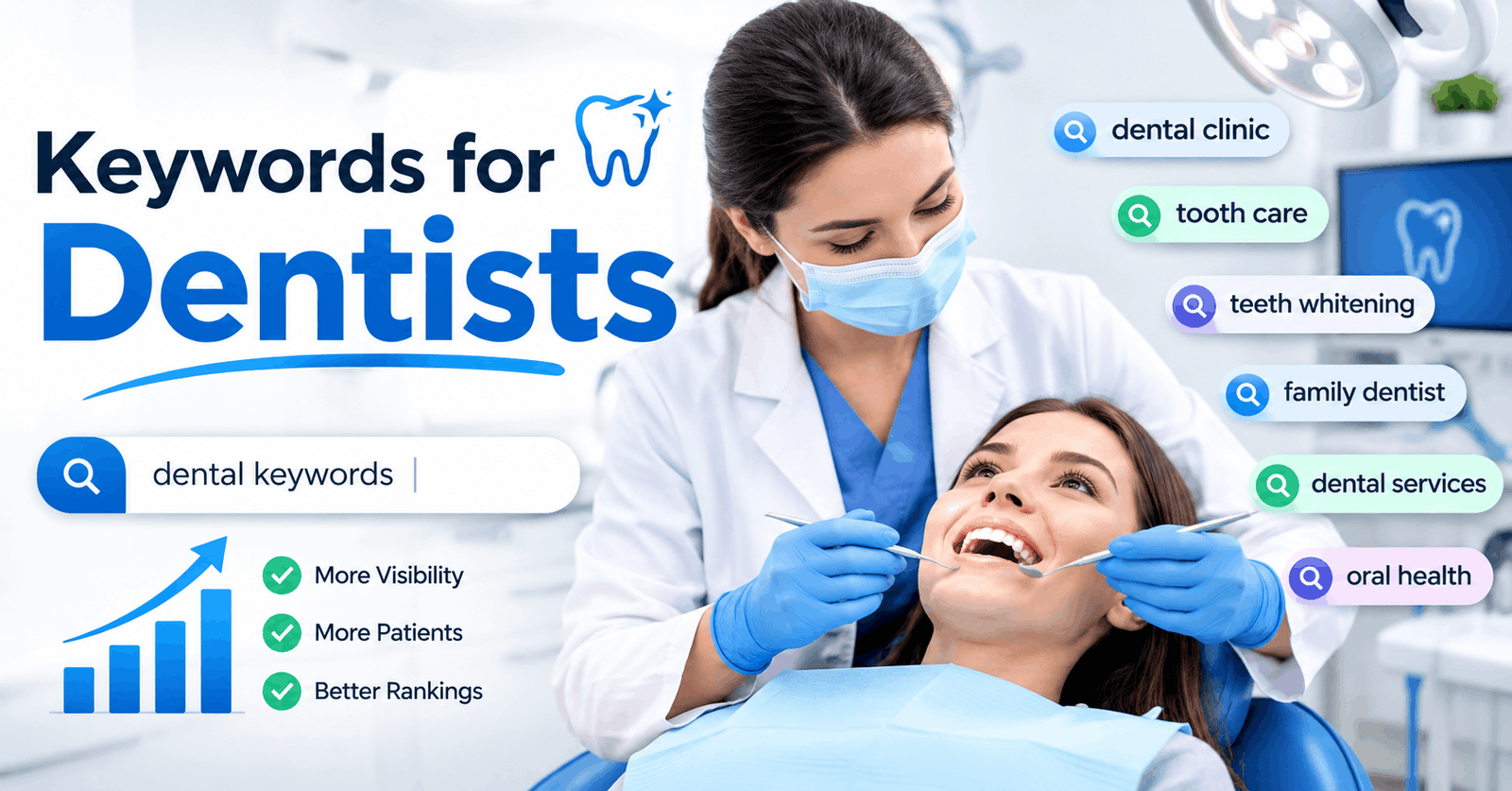
Every category of keyword a dental practice can target, organized by patient intent rather than alphabetized — plus real search-volume data, a prioritization framework, and the exact process to build a list for your own practice.
dentist near meemergency dentistdental implantsteeth whiteningpediatric dentistInvisalign costkeywords for dentistsDental SEO Keyword ResearchA dental practice’s keyword map: local, procedure, and urgency terms feed one search.
On this page
- Why dentist keywords matter
- Keyword categories at a glance
- The complete keyword list, by category
- High-volume dental keywords & competition
- Dental implant keyword funnel
- Pediatric dentist keywords
- Voice search & AI search keywords
- Keywords to skip
- How to do your own keyword research
- How to actually use these keywords
- Mapping keywords to pages
- Common mistakes
- FAQs
Why dentist keywords matter
Patients don’t scroll to page two. They search “dentist near me,” look at the first three or four results and the map pack, and pick one. If a practice’s website doesn’t use the words patients actually type — rather than the clinical terms a dentist would use — it simply doesn’t show up for that decision. Keyword research is the step that closes that gap: it tells you, in the patient’s own language, what to put on your homepage, your service pages, and your blog.
This matters more than most practices assume. Survey data on dental patient behavior consistently shows that the large majority of people research a dentist online before ever picking up the phone, and a strong share of them take action — a call, a form, a booking — directly from that search. Two figures come up again and again in dental marketing research:
~71%
of people searching for a dentist use a search engine before booking an appointment
~86%
of those searchers say they contacted a practice directly after finding it in search results
In other words, keyword research isn’t a technical SEO exercise sitting apart from patient acquisition — it is patient acquisition, several steps upstream. Get the list right, and every other piece of dental SEO (page structure, content, Google Business Profile) has something solid to point at. Get it wrong, and you can build a beautiful website that never surfaces for the searches that would have filled your chair.
Keyword categories at a glance
Dental keywords aren’t one big undifferentiated list — they cluster around a few different things a patient is trying to accomplish. Understanding the category tells you where a keyword belongs on your site and how close that searcher is to booking.
| Category | Example | Patient intent | Best page type |
| Core & local | dentist near me, dentist [city] | Local, ready to book | Homepage / location page |
| Trust & review | best dentist near me | Comparing providers | Google Business Profile |
| Procedures | root canal, dental crown | Service-specific | Dedicated service page |
| Cosmetic | veneers, smile makeover | Higher value, comparison-driven | Cosmetic service page |
| Implants | dental implants [city] | High-ticket, full funnel | Implant page + cost guide |
| Invisalign / ortho | Invisalign cost | Education to booking | Orthodontic page |
| Emergency | emergency dentist near me | Immediate booking | Emergency page |
| Symptom-based | broken tooth, bleeding gums | Informational, close to booking | Blog, linked to service page |
| Pediatric / family | kids dentist near me | Trust-driven | Pediatric page |
| Sedation / anxiety | sedation dentist near me | Reassurance-driven | Sedation page |
| Insurance / cost | dentist that accepts [insurance] | Afford-focused, booking-ready | Insurance / financing page |
| Specialty | periodontist near me | Referral or in-house | Specialty page, if offered |
| Long-tail questions | does a root canal hurt | Research stage | Blog / FAQ |
The complete keyword list, by category
This is the working list. It’s grouped the way patient intent actually clusters, not alphabetized — use it as a starting framework, then trim it to the services, insurance plans, and age groups your practice genuinely offers.
Core & local dentist keywords
The keywords every practice needs regardless of specialty. These should map to your homepage and location pages, and every other category should link back to one of them.
dentist near medentist [city]dental clinic near medental office near mefamily dentist near menew patient dentist [city]dentist accepting new patientsgeneral dentist near mewalk-in dentist [city]local dentistnearest dentist
Trust & review keywords
These aren’t won through content alone — they’re earned through review volume, recency, and a complete Google Business Profile.
best dentist near metop rated dentist [city]best dentist in [city]dentist reviews [city]most trusted dentist near megood dentist near me
Procedure & service keywords
One cluster per procedure, one page per procedure — a single generic “our services” page won’t outrank a dedicated page for any of these.
teeth cleaning near medental fillingscomposite fillingsdental crownsame day crownroot canal [city]tooth extraction near mewisdom tooth removaldentures [city]denture repair near medental bridge costgum graftingbone grafting for implants
Cosmetic dentistry keywords
Patients compare providers deliberately here, so these pages convert best with proof — before/after photos and credentials — not just a service description.
cosmetic dentist near medental veneersporcelain veneersteeth whitening near metooth bleachingteeth bondingsmile makeovertooth contouring
Dental implant keywords
Implants are consistently the highest search-volume, highest-value restorative category, and the one most practices under-build with a single paragraph on a general services page.
dental implants near meimplant dentist near medental implant costaffordable dental implantssame day dental implantsimplant-supported denturesdental implants payment plansfull mouth dental implants [city]
Invisalign & orthodontic keywords
This category sits between informational and transactional — most searchers need educating before they’ll book a consult.
Invisalign [city]Invisalign costInvisalign teenclear aligners near meInvisalign vs bracesorthodontist near mebraces for adults
Emergency & same-day keywords
High intent, immediate booking — but only target “open now” or “walk-in” phrasing if it’s genuinely true. Ranking for availability you can’t deliver produces the worst kind of call.
emergency dentist near meemergency dental clinictooth pain dentist open nowbroken tooth dentist near me24 hour dentist [city]dentist open Saturdayurgent care dentistwalk in dentist near me
Symptom-based keywords
Informational on the surface, close to booking once the searcher understands what’s happening. Answer the question in the first two sentences, then link to the relevant service page.
broken toothbleeding gumstooth sensitivity after fillingwhat to do if a crown falls outsigns you need a root canalhome remedies for toothache
Pediatric & family dentistry keywords
pediatric dentist near mekids dentist near mechildren’s dentist near mefamily dentist [city]first dental visit for toddlersgentle dentist for anxious kids
Sedation & anxiety keywords
Only build these pages if sedation is genuinely offered — a page promising comfort options you don’t have creates the same trust problem as false emergency availability.
sedation dentistry near mesleep dentistryfear-free dental visitsnitrous oxide dentistpainless dentist [city]anxiety-free dental care
Insurance, financing & cost keywords
High volume, mixed intent — the converting subset is patients who’ve already decided on treatment and are looking for a way to afford it.
dentist that accepts [insurance] near medental payment plansaffordable dentist near medentist without insurancedental financing [city]new patient special [city]Delta Dental [city]Cigna dental [city]Aetna dental insurance
Specialty keywords
Only target these if the service is genuinely offered in-house, or if the page clearly explains a referral relationship.
orthodontist [city]periodontist near meendodontist [city]oral surgeon near meprosthodontist near me
Long-tail question keywords
Lower individual volume, easiest to rank for, and increasingly the terms that get pulled into AI-generated answers.
how much are dental implants without insurancedoes a root canal hurthow often should I see a dentisthow long do veneers lastbest dentist for nervous patients [city]
High-volume dental keywords & competition
Category tells you where a keyword belongs; volume and competition tell you what to prioritize first. The table below compiles average monthly search volume and typical keyword-difficulty ratings pulled from keyword-planner data across the “dentist” and “dental” keyword space — treat the figures as directional, since actual volume always shifts by market and season.
| Keyword | Avg. monthly searches | Competition |
| dentist near me | ~2,200,000 | Low |
| dentist | ~1,200,000 | Low |
| orthodontist | ~246,000 | Low |
| emergency dentist near me | ~201,000 | Low |
| dental implants | ~201,000 | Low |
| pediatric dentist near me | ~201,000 | Low |
| dental office near me | ~165,000 | Low |
| tooth whitening / bleaching | ~165,000 | High |
| endodontist | ~135,000 | Low |
| dental clinic near me | ~90,500 | Low |
| family dentistry | ~90,500 | Low |
| periodontist | ~90,500 | Low |
| dental implants near me | ~74,000 | Low |
| cosmetic dentistry | ~74,000 | Low |
| teeth whitening near me | ~49,500 | Low |
| childrens dentist near me | ~49,500 | Low |
| dentures near me | ~40,500 | Medium |
| best dentist near me | ~40,500 | Low |
| walk in dentist near me | ~33,100 | Medium |
| family dentist near me | ~33,100 | Low |
Reading the table: low competition next to a seven-figure search volume is unusual and is largely a function of how many practices are eligible to rank locally at once — it doesn’t mean the term is easy to win in your specific market. Always sanity-check national averages against your own city before betting a content budget on them.
Dental implant keyword funnel
Implants deserve a dedicated section because they’re the highest-value category in dental search, and the one practices most often under-invest in — a single paragraph on a general services page instead of a real funnel. Implant keywords fall into three stages:
- Awareness: dental implant cost, how much are dental implants, am I a candidate for implants
- Comparison: all-on-4 vs. individual implants, implants vs. bridge, implant-supported dentures
- Local commercial: implant dentist near me, dental implants [city], full mouth dental implants [city]
Two things separate an implant page that converts from one that doesn’t. First, length: implant patients are researching a $3,000–$20,000+ decision, so a 200-word page won’t hold their attention or Google’s — aim for 1,500 to 2,500 words that actually walk through the procedure, timeline, and candidacy. Second, price transparency: patients searching cost keywords will leave to find pricing elsewhere if your page doesn’t at least give a range.
Pediatric dentist keywords
Parents searching for a children’s dentist are optimizing for trust and comfort more than price, which shows up in the long tail of this category — terms like “autism friendly dentist near me” or “gentle dentist for anxious kids” carry lower volume but very high intent.
pediatric dentist near mekids dentist near mechildrens dentaldentist for kidspediatric orthodontistinfant dentist near meemergency pediatric dentistautism friendly dentist near mebest pediatric dentist near meaffordable pediatric dentist near me
Most of these terms sit in the low-hundreds to low-thousands of monthly searches nationally, which is smaller than the core “dentist near me” category — but they convert at a high rate for practices that genuinely offer pediatric-friendly care, and they face noticeably less competition.
Voice search & AI search keywords
Voice queries are longer, more conversational, and default to local. Someone typing searches “emergency dentist near me.” Someone speaking to their phone asks what the closest emergency dentist is that’s open right now. These don’t need a separate content plan — they need the categories above rewritten as full questions:
- “who’s the best dentist near me for kids” (pediatric)
- “where can I get a same-day dental crown” (procedure + emergency)
- “does my insurance cover dental implants” (implant + insurance)
- “what’s the closest dentist open on Saturday” (emergency)
Two things make a page voice- and AI-ready: an FAQ section written in the actual question form, not just the keyword, and accurate structured business information (hours, services, location) that assistants can pull from directly. AI Overviews, ChatGPT search, and Perplexity all favor pages that answer the question in the first sentence, use structured content like tables and numbered steps, and come from a source that demonstrates real expertise rather than repeating the keyword. Service and “near me” keywords are less likely to get answered by AI directly — those searches still favor the Local Pack and map results, which is one more reason “near me” optimization runs through your Google Business Profile, not blog content.
Keywords to skip
Not every high-volume, dentist-adjacent term is worth targeting. These attract job seekers, students, and people actively avoiding a dentist visit — not patients:
dental jobsdentist salarydental assistant salarydental schoolhow to become a dentistDIY tooth extractionhome tooth filling
Building organic pages around these dilutes the pages that actually convert. If you run Google Ads, add them to your negative keyword list too — they show up in the same broad-match auctions as legitimate dental terms and burn budget on searches that were never going to book.
How to do dental keyword research for your own practice
The list above is a starting framework, not a finished strategy. Here’s the process for building a keyword list specific to your services, your city, and your competitors.
- List every service in patient language. “Endodontic therapy” becomes “root canal.” Patients don’t search clinical terms.
- Add location modifiers. City, neighborhood, and “near me” variants for every service — this is where most of your realistic search volume actually lives.
- Check Google autocomplete and “People Also Ask.” Type each service into Google and note what it suggests. Those are real searches happening right now.
- Pull Google Search Console data. Queries already generating impressions, especially ones ranking on page two, are your fastest wins — Google is already showing your site for them.
- Audit three competitors per keyword. Note which practices rank for your target service-plus-city combinations, and what their pages cover that yours doesn’t.
- Map each cluster to exactly one page. No page should target more than one primary keyword and two or three close variants.
- Prioritize with a two-factor method. When you have keyword-tool data, rank by volume and difficulty together — high volume with low difficulty is a genuine quick win. When you don’t, score each term against appointment intent, treatment value, urgency, whether you actually offer the service, and how much trust-building the page needs.
How to actually use these keywords
On-page optimization
Add your chosen keywords naturally to headings, meta titles, meta descriptions, and body content — including image alt text, which helps both accessibility and search visibility.
Content marketing
Write blog posts that answer specific patient questions — “when should a wisdom tooth come out,” “what to expect during a dental implant consult” — and let the keyword occur naturally rather than being forced in. Patient testimonials and Q&A-style content build authority around the same terms.
Local SEO
Optimize your Google Business Profile with relevant service and location keywords, and create dedicated landing pages per location if you serve more than one. Quality still beats quantity here — write for readability first, and let keyword presence follow naturally instead of stuffing terms into unreadable copy.
Mapping keywords to pages
This is where keyword research actually moves the needle — not in density, but in site architecture. Once keywords are grouped into categories, each one needs exactly one home:
/
/services/teeth-cleaning/
/services/dental-implants/
/services/invisalign/
/services/cosmetic-dentistry/
/services/emergency-dentist/
/services/root-canal/
/services/dentures/
/pediatric-dentistry/
/sedation-dentistry/
/insurance-and-financing/
/locations/[city]/ (repeat per location served)
/blog/[symptom-or-question-topic]/
Commercial-intent keywords — service plus city, “near me,” emergency — belong on dedicated service and location pages. Informational and long-tail question keywords belong on the blog, and every blog post should link back to the service page it supports. That link is what turns a top-of-funnel search into a booked appointment, not the blog post alone.
Common mistakes when choosing dentist keywords
- Chasing volume over intent. A broad term with huge volume and vague intent often converts worse than a smaller, specific one, even when it looks better in a report.
- Skipping location modifiers. A page targeting a procedure with no city or “near me” variant ends up competing nationally for what’s actually a local service.
- Cannibalizing your own rankings. Multiple pages targeting the same keyword split authority instead of combining it.
- Targeting services or insurance you don’t offer. A page promising sedation, a specialty, or an insurance plan you don’t provide generates calls that end badly.
- Treating research as one-and-done. Search behavior shifts with new services, new locations, and new competitors — revisit the list at least twice a year.
FAQs
What are the best keywords for a dentist?
The keywords with the strongest combination of commercial intent and local relevance perform best: “dentist near me,” “[city] dentist,” “emergency dentist near me,” and procedure-specific local terms like “dental implants [city].” High-intent local keywords generally convert better than high-volume informational ones for most practices.
How many keywords should a dental website target?
There’s no fixed number — it depends on your services and locations. As a rough guide, each service page should target one primary keyword and two to three close variants, multiplied by every location you serve. A practice with five services and two locations is realistically working with 10 to 15 core page-level targets, plus a longer tail of blog and FAQ keywords underneath.
Do dentist SEO keywords differ for voice search?
The categories stay the same; the phrasing changes to full questions. A page that already answers common patient questions directly — in a clear FAQ section, for example — is largely voice-ready without additional work.
Are dental SEO keywords still relevant with AI search?
Yes. AI Overviews and answer engines pull from pages that already rank well for specific, well-structured queries. Keyword targeting remains the foundation that makes content findable by both traditional search and AI-generated answers — the format just needs to answer the question directly and early on the page.
How often should a dental practice update its keyword list?
At minimum twice a year, and any time your services, locations, or major local competitors change. Search behavior shifts continuously, and a list built two or three years ago is likely missing newer high-intent terms like specific insurance plans or newer procedures you’ve since added.
Methodology & sources
This guide was compiled by grouping dentist-related search terms into intent-based categories and cross-referencing average monthly search volume and competition data from keyword-research tools (including Google Keyword Planner-style reporting). Search volume figures are national averages and directional rather than exact — always validate against your own city and keyword-research tool before committing a content budget. Last reviewed and updated September 2026.