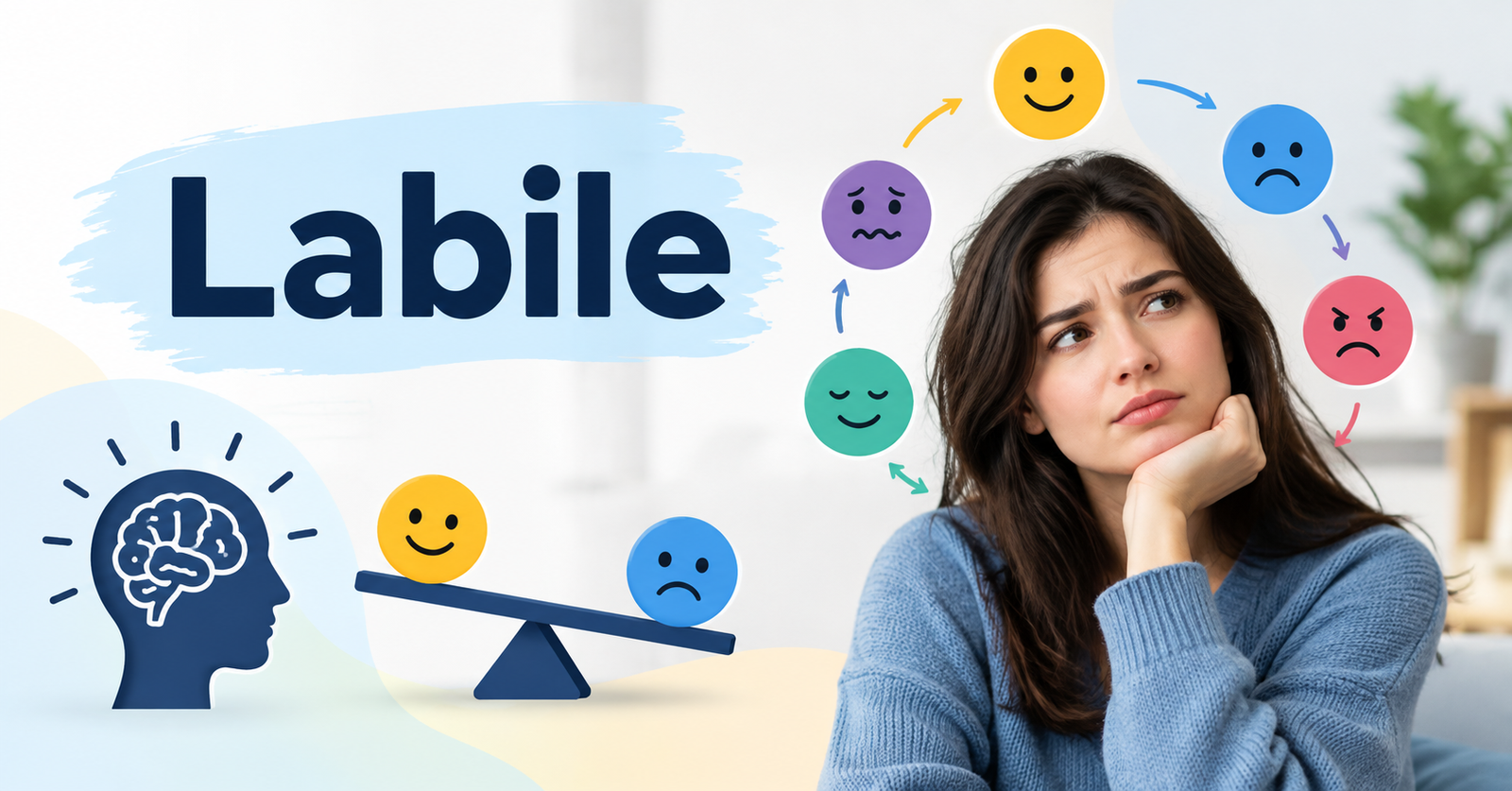
If you have come across the word “labile” in a chemistry textbook, a doctor’s report, or a psychology article, you are not alone in wondering exactly what it means. Labile is one of those flexible English words that changes its precise shade of meaning depending on the field it is used in — but at its core, it always points to one idea: instability and a tendency to change.
In this comprehensive guide, we will break down the meaning of “labile” across dictionaries, explore its Latin origin, and explain how the word is used differently in chemistry, medicine, and psychology. We’ll also look closely at “labile mood” (also called emotional lability), its causes, symptoms, and how it can be managed — a topic that matters to millions of people dealing with mood-related conditions.
What Does “Labile” Mean?
According to Merriam-Webster, labile is an adjective with two primary senses:
- Readily or continually undergoing chemical, physical, or biological change or breakdown; unstable — for example, “a labile mineral.”
- Readily open to change — as in someone having “so labile a face” that their expressions shift constantly.
Vocabulary.com describes labile as a word used to describe something that is easily or frequently changed. It gives a vivid example: radioactive elements such as uranium or plutonium are labile, and it is this “lability” that makes them unstable and potentially dangerous. The site notes that labile is especially common in technical and scientific writing, where it describes compounds that break down easily (in chemistry) or people who are emotionally unstable (in psychology).
RxList, a medical reference source, defines labile simply as “unstable.” It gives the example of labile blood pressure — blood pressure that abnormally rises and falls frequently, rather than staying in a steady, predictable range.
The Cambridge Dictionary similarly frames labile as something liable to change quickly, reinforcing the same underlying theme found across every source: labile things do not stay still. Whether we’re talking about a chemical compound, a person’s blood pressure, or someone’s emotions, the word always signals that stability cannot be taken for granted.
Pronunciation and Word Origin
Labile is pronounced /ˈleɪ-baɪl/ or /ˈleɪ-bəl/ (LAY-byle or LAY-bull), depending on regional accent.
The word has a rich etymological history. According to Merriam-Webster, labile was borrowed into English from French, tracing back through Middle French labile (meaning “prone to err”) to the Latin verb labi, meaning “to slip or fall.” The first known use of the word in English dates back to 1603, when it originally meant “prone to slip, err, or lapse” — a sense that is now obsolete.
Interestingly, several other common English words share this same Latin root labi:
- Collapse — to fall down or in
- Elapse — to slip away (as in time)
- Prolapse — to slip forward or down
- Lapse — a slip or failure
So the next time you use any of these words, remember they all share a linguistic ancestor with “labile” — the shared idea of slipping, sliding, or losing stability.
Table: Meaning of “Labile” Across Different Fields
| Field | Meaning of “Labile” | Example Usage |
| General / Everyday English | Liable or open to change; not fixed | “His mood was labile throughout the meeting.” |
| Chemistry | A compound that readily reacts, breaks down, or changes under heat, light, or other conditions | “The labile compound decomposed quickly when exposed to sunlight.” |
| Medicine | A condition marked by frequent, abnormal fluctuation (blood pressure, blood sugar, etc.) | “The patient was diagnosed with labile hypertension.” |
| Biology | A cell, protein, or antigen that changes or breaks down easily | “Labile proteins lose their structure when pH changes.” |
| Psychology / Psychiatry | Rapid, uncontrollable shifts in mood or emotional expression | “Emotional lability is common in patients with certain neurological conditions.” |
This table highlights why context matters so much when you encounter the word “labile” — the same adjective can describe a chemical reaction, a vital sign, or a person’s emotional state.
Labile in Chemistry
In chemistry, a labile compound is one that undergoes change, reaction, or breakdown relatively easily, often in response to heat, light, pH, or the presence of another reactive substance. Scientists frequently contrast labile compounds with stable or inert compounds, which resist change under similar conditions.
A classic example is a labile coordination complex in inorganic chemistry, where ligands (the molecules or ions bonded to a central metal atom) can be swapped out quickly. Similarly, in organic chemistry, certain functional groups are described as “heat-labile” because they degrade when exposed to elevated temperatures — a term especially important in pharmaceutical manufacturing, where drugs must be stored and processed carefully to avoid breakdown.
Labile in Medicine
In a medical context, “labile” typically describes a physiological measurement or condition that fluctuates abnormally. According to RxList, the most common example is labile blood pressure — blood pressure readings that swing unpredictably between high and low, rather than remaining relatively steady.
Other medical uses include:
- Labile diabetes — a form of diabetes marked by unpredictable and difficult-to-control blood glucose levels, sometimes swinging between hypoglycemia and hyperglycemia within the same day.
- Labile antigen — an antigen that changes or degrades relatively easily, which matters in immunology and vaccine development.
- Labile affect — the outward emotional expression that shifts rapidly, often seen alongside neurological or psychiatric conditions (discussed in more detail below).
For patients, a labile reading in any of these areas is generally a signal to their healthcare provider that closer monitoring or adjusted treatment may be needed, since unpredictability itself can pose health risks.
Labile Mood: Meaning, Signs, and Causes
Perhaps the most searched-for use of this word in everyday life relates to mental health: labile mood, also known as emotional lability.
What Is a Labile Mood?
A labile mood is characterized by rapid, often uncontrollable emotional swings — such as sudden laughing or crying without any clear trigger, or exaggerated emotional reactions that don’t match the situation. It’s important to note that a labile mood is not a standalone personality disorder; rather, it is often a symptom of an underlying mental health or neurological condition.
Key signs of a labile mood include:
- Sudden outbursts of laughter or crying with no obvious cause
- Emotional expressions that feel out of place, such as giggling during a serious conversation
- Occasional aggression, angry outbursts, or even self-destructive behavior in more severe cases
Is Labile a Mood or an Affect?
There’s a subtle but important distinction between mood and affect. Mood refers to a person’s internal emotional state, while affect refers to the outward, observable expression of that state. Because a labile mood typically shows up as visible laughing, crying, or emotional outbursts, it involves both mood and affect — which is why the terms “labile mood” and “labile affect” are often used interchangeably in clinical settings.
Common Causes of Labile Mood
1. Underlying mental health conditions, such as:
- Borderline Personality Disorder (BPD) — marked by ongoing mood instability, impulsivity, and relationship difficulties
- Bipolar Disorder — characterized by dramatic mood swings between manic and depressive episodes
- ADHD — which can involve emotional dysregulation, particularly under stress or overstimulation
2. Neurological conditions, including brain injuries (strokes, concussions, skull fractures) and diseases like dementia, Alzheimer’s, multiple sclerosis, and ALS, all of which can disrupt the brain’s ability to regulate emotion.
3. External stressors, such as the death of a loved one, chronic neglect, or other traumatic experiences, which can trigger temporary episodes of emotional lability even without an underlying diagnosis.
Does Labile Mood Go Away?
In mild cases, coping strategies like better stress management and mindfulness can help stabilize emotional swings, and some people find the symptoms fade naturally once the underlying stressor passes. In severe or chronic cases — particularly those tied to brain injury or a psychiatric condition like BPD or bipolar disorder — professional treatment, including therapy and/or medication, is often necessary for lasting improvement.
How to Manage Emotional Lability
Managing a labile mood typically involves a combination of medical and lifestyle approaches:
1. Medication options (under professional guidance):
- Mood stabilizers such as lithium, valproic acid, or carbamazepine
- Low-dose antidepressants to reduce the intensity of emotional outbursts
2. Self-awareness practices:
- Identifying personal triggers (noise, crowds, conflict, etc.)
- Keeping a mood journal to track emotional patterns over time
3. In-the-moment coping techniques:
- Pausing and stepping away from a triggering situation
- Practicing slow, deliberate breathing exercises
- Using distraction techniques, such as counting or a quick task switch
- Engaging in positive self-talk to reassure yourself the wave will pass
4. Communication and support:
- Explaining the condition to close friends or family so they understand and can offer support
- Setting boundaries around environments or situations that tend to worsen symptoms
The Role of Professional Counseling
For people whose labile mood significantly disrupts daily life, working with a licensed therapist or counselor can make a real difference. A mental health professional can help identify underlying issues (such as an undiagnosed condition or past trauma), teach personalized coping strategies, and provide ongoing support as treatment progresses. For labile moods tied to chronic conditions like bipolar disorder, consistent therapy — sometimes combined with medication — can significantly improve quality of life over the long term.
Synonyms and Related Words
- Synonyms: unstable, volatile, mutable, changeable, fluctuating, reactive (in chemistry contexts)
- Antonym: stable
- Noun form: lability — the state or quality of being labile
Labile in a Sentence
- “The labile nature of the compound made it difficult to store safely.”
- “Doctors noted the patient’s labile blood pressure during the checkup.”
- “After the brain injury, his emotionally labile reactions surprised his family.”
Frequently Asked Questions (FAQs)
1. What does “labile” mean in simple terms?
In simple terms, labile means something that changes easily or is unstable. It can apply to a chemical compound, a medical measurement like blood pressure, or a person’s emotions.
2. What is a labile mood?
A labile mood, also called emotional lability, refers to rapid and often uncontrollable shifts in emotion, such as sudden crying or laughing without a clear trigger. It can be a symptom of conditions like bipolar disorder, BPD, ADHD, or certain neurological injuries.
3. What causes labile blood pressure?
Labile blood pressure can be caused by stress, anxiety, hormonal changes, certain medications, or underlying cardiovascular or neurological conditions. It is generally identified through repeated readings that show significant, unpredictable fluctuation.
4. Is a labile mood the same as bipolar disorder?
No. A labile mood is a symptom that can appear in bipolar disorder, but it can also occur due to other conditions like BPD, ADHD, neurological injury, or even temporary stress. Bipolar disorder involves a broader, longer-lasting pattern of manic and depressive episodes.
5. Can a labile mood be treated?
Yes. Depending on the underlying cause, treatment may include mood stabilizers or antidepressants, therapy, stress-management techniques, and lifestyle changes. Mild cases often improve with self-help strategies, while more severe or chronic cases usually benefit from professional care.
Conclusion
The word “labile” may look simple, but it carries meaningful weight across science and medicine. In chemistry, it describes compounds ready to change or break down. In medicine, it flags dangerous fluctuations in vital signs. And in psychology, “labile mood” points to real emotional experiences that deserve understanding, compassion, and — when needed — professional support. Whether you encountered this word in a textbook or because you or someone you love is experiencing emotional lability, understanding its full meaning is the first step toward making sense of it.